|
>>
The Swampland Flora
The great territorial extension and climatic diversity
of Brazil explain the vegetable wealth that the country possesses.
The native and exotic vegetable species known just represent
a sample of the ones that exist probably (it is believed that
only met 60 to 80%). Great part of the primitive vegetable
covering was already and it continues being devastated, creating
risks of accidents and ecological unbalances.
The Brazilian flora is dispersed for several habitats, from
earth forests strong to the fields with vegetation of small
plants and mosses. Most part of the Brazilian flora is in
the Atlantic forest and in the Amazonian forest, although
the Swampland sul-matogrossense it also presents great vegetable
variety.
Besides the native plants, the Brazilian flora received copies
of other tropical areas brought by the Portuguese during the
colonial period. Several of those species they limited the
agricultural areas as the rice, the sugarcane, the banana
and the citric fruits. Other they adapted well and they dispersed
for the forests such point that they are confused with native
species. The medicinal plants are used thoroughly by the population,
although little it is known scientifically about their use.
The indigenous population also used them and they still use
the Brazilian flora, however such knowledge has in lost with
acculturation by the white man. It is possible that a lot
of species of Brazilian plants have therapeutic use still
unknown. That knowledge however it is threatened by the deforestation
and for the expansion of the agricultural lands.
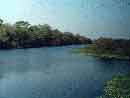
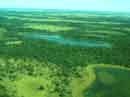
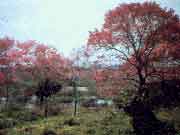
The Swampland has a very rich flora that it is formed by plants
arrivals of the Savannah, of the Amazonian (camalote and royal
Vitória), of Chaco and of the South American fields,
rarely they are exclusive of the area. The vegetation is varied
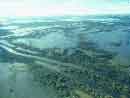
mainly because of the flood and of the soil. During the drought
that coincides with the winter, the fields become yellowish.
The vegetation of the Swampland is not homogeneous and the
flora can differ in agreement with the altitude. In the bays,
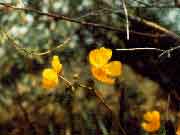
that are ponds temporary or permanent, we found aquatic plants
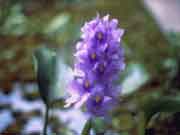
submerged or flotation. In the permanent waters they are common
the camalotes and the baceiro or batume, that it is a formed
flotation vegetation to put ciperáceas and other aquatic
plants. Those plants are important for the survival of the
aquatic fauna.
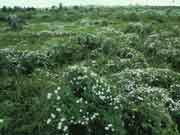
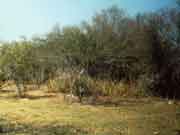
In the cordilleras, where the lands are not flooded, there
is savannah vegetation, cerradão or mata. In the fields,
areas flooded that is sometimes confused as a result of the
deforestation, the grassy ones prevail. The Capão is
a stain of arboreal vegetation of savannah, cerradão
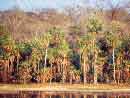
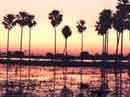
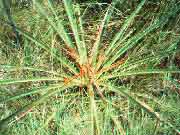
or matas that forms islands in the fields. In Carandazal area
also flooded has the Carandá, a palm tree of Chaco
with leaves in fan form, relative of the carnauba of the Northeast
and whose wood is used for fences and constructions. In the
salt beds, ponds of salty water, we found great amount of
algae that give green color the water. The ebb tide, which
is a temporary river, when it is in the drought period, is
covered with grassy, forming areas of natural pasture for
the cattle.
The savannah has two stations well marked, the drought and
the rainy. The soil is predominantly sandy and copper most
of the Swampland. The use of that area a very little time
before was small, but today is changing with the increase
of the grains cultivation, mainly of the soy in the center-west.
The general state of conservation according to studies of
Embrapa (the governement enviroment cientific department)
is still good, and 50% is still in natural state. But critical
areas that already need conservation or recovery, where the
cultivated pastures in declived lands, the ciliary exist's
forests of streams and mined areas. A fourth of the areas
earth is cultivated pastures used in the livestock. The agriculture
is practiced exclusively in the establishments with the bean
production, rice, corn, cassava, fruits and vegetables. The
soil used a lot of times is not ideal for farming, although
chemically fertile, because it is shallow or of clay that
hardens with the earth preparation.
>> Voltar ao Topo
|



 |